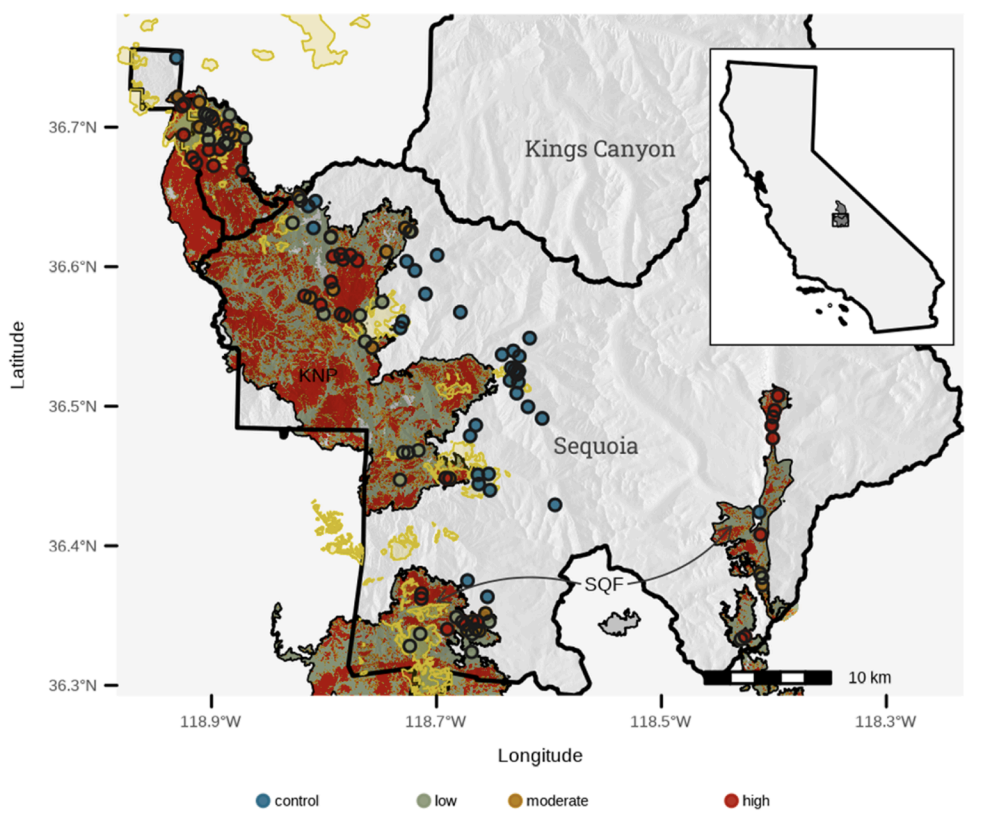
Das, A., Rosenthal, L., Shive, K. “The effectiveness of wildfire at meeting restoration goals across a fire severity gradient in the Sierra Nevada”. Forest Ecology & Management. 2025.
Analysis of wildfires in the southern Sierra Nevada quantifies post-fire fuel loading across a severity gradient and assesses the impact within the context of the National Park’s fuel management plan. Highlights include:
- Fine fuels declined with severity, while coarse fuels were more variable
- Low and moderate severity wildfire effects align with short-term management goals
- Abundant standing fuels and lack of heterogeneity may reduce long-term resilience
- Large tree densities tended to fall below management targets even in control areas
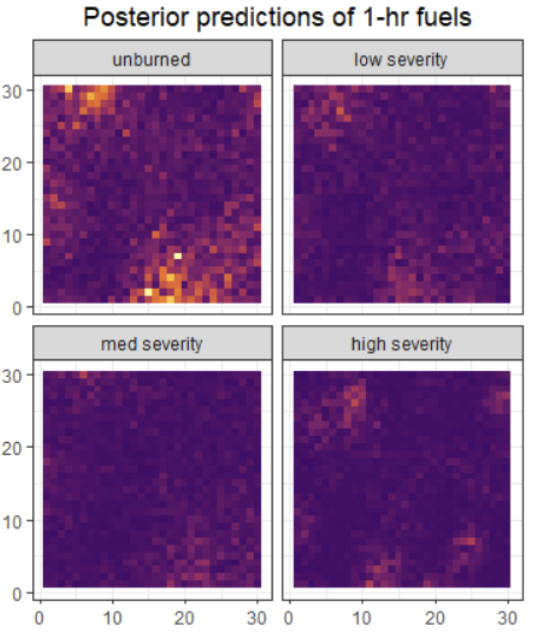
This paper was just the tip of the iceberg in the fuels analysis that I conducted. The much larger goal was to examine fine-scale spatial heterogeneity of surface fuels. Ultimately, this work is needed to build fuel models at high spatial resolution for next-generation fire behavior models. I developed hierarchical Guassian Process models to statistically estimate the spatial turnover of various fuel components. I used K-fold cross-validation to test the predictive performance of the models, running multiple models in parallel on a high performance computing cluster.
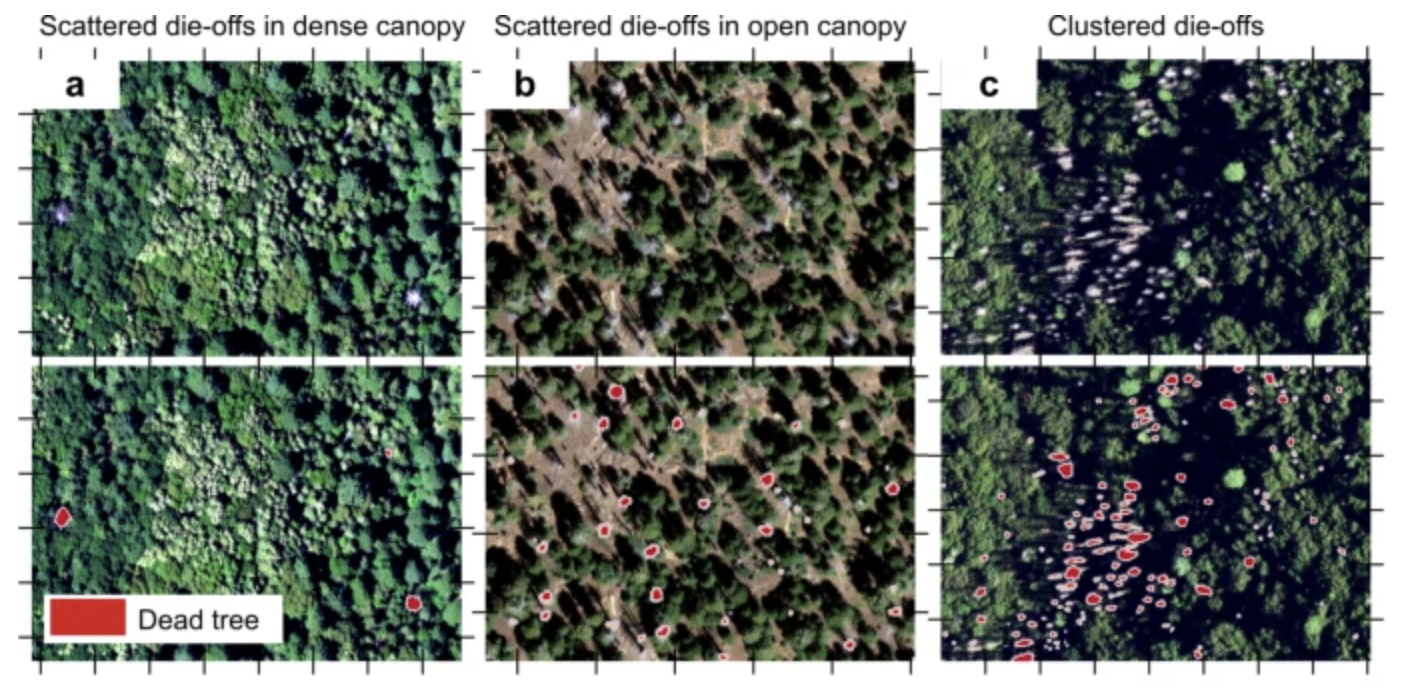
Cheng, Y., Oehmcke, S., Brandt, M., Rosenthal, L., Das, A., Vrieling, A., Saatchi, S., Wagner, F., Mugabowindekwe, M., Verbruggen, W., Beier, C., Horion, S. “Scattered tree death contributes to substantial forest loss in California”. Nature Communications. 2024.
During my time at USGS, I also coauthored a publication focused on detecting tree mortality using high-resolution NAIP imagery with a deep learning model. Check it out here: